Tuesday, July 10, 2012

When a Plop Flops

Doesn't this look like fun?
ball ramps
Yep.  I thought so too.  It was a rainy day, my crew has energy and we hadn't played inside for weeks (thanks to gorgeous weather outside).  A ramp day was a PERFECT PLAN.           
 read more about ramp day

Lesson learned....once again, children teach me.

I thought the ramps would be fun, but when the children arrived, they played with the ramps and balls long enough to make a mess (5 minutes). 


Then, every single child migrated over to the markers, paper and tables and sat down to draw.  Of course!  Duh!  That is something we hadn't done for weeks! ( It is so windy in SD, drawing on paper outside is usually a frustrating event, yet, full of fun and valuable learning too! )

So, I let them draw....right?

Wrong....I totally reverted back to my "old ways" of telling children what we are going to do.  I was feeling frustrated about the fact that I had gone through all the trouble of setting up the ramps, and no one was playing with them. 

Do you know what I did?!  I completely broke the main rules of "plopping".

Basically a plop is:  to quietly place something new into the environment, and then FOLLOW THE CHILDREN'S LEAD.   Be PATIENT and see what evolves.  QUIETLY observe and leave your adult ideas out.

Instead of following my own rules, I said:
"Okay boys and girls.  Finish up your drawings and put the markers away.  We are going to play with the ramps."

The silence in the room was louder then all of them screaming.  The looks on their faces spoke volumes.
 I had made a mistake, and it felt awkward and icky.  My children had grown accustomed to my "plopping" ways of planning a plop, and then stepping back and following their lead, adding to the plop when asked, and assisting the children only when necessary in order to achieve their thoughts and ideas.  ( I am a huge fan of fostering young children to ask for what they need in order to solve problems and try new ideas)

I quickly saved the moment by saying:

"Would you all like to get out the great big paper and draw on the floor today?"

The smiles and excitment quickly returned as everyone finished their pictures and helped move the tables out of the way.  We drug out the roll of paper (children helping gives them ownership of the activity), rolled it across the floor and Ty cut it.

Immediately everyone found a spot around the paper and the illustrated stories began.  Children were collaborating and compromising as paper space was shared and story lines crossed.

So....what about the ramps?

I simply plopped magnets next to the paper ramp.  This time, I followed my rules,  just look what evolved:
magnets


Learning through trial and error.  Making new discoveries is very empowering for young children!  Sharing those discoveries builds confidence!!


In order for the boys to build these creations, they had to be aware of where there hand was
even when they couldn't see it.  GREAT for proprioception development, spatial awareness, visual planning and
sense of pride!


 The plop flop led to this set up on another day:

Ty created a swing!!  This swing idea later turned into airplane controls!!  Minds at work.  Using
imagination to invent something new!


When a plop flops....a lot of learning occurs, for the children AND me!!

What I learned:
1)  Children enjoy making choices and leading.
2)  Making children follow my plans just feels wrong. 
3)  I CAN trust children to lead their learning.
4)  Adding to the original plop can sometimes save a flopped plop.
5)  Relax.

What the children learned:
1)  How to communicate their needs.  They needed a quiet day...and they told me loud and clear with deafening silence, body language and facial expressions.  Quickly followed with words.
2)  They were empowered when I listened to their needs.
3)  They learned through trial and error using the magnets on the ramp.
4)  Putting magnets together when they can't see their other hand was GREAT for their proprioception development (awareness of how our body moves through space and where it is in space)
5)  Creativity, imagination, teamwork, cooperation, compromise, sharing, solving problems, learning through errors, persistance and making discoveries (to quickly name a few more!!)

Sunday, July 1, 2012

Firework Painting

As we approach the 4th of July, I wanted to highlight a fantastic thing we did last year, but instead of writing about it all over again, I decided to just put a link to the original!

Happy Fourth everyone!  Take time to enjoy your family and friends!!

Firework Painting

Friday, June 8, 2012

The Power of Reactions

Children like to cause reactions. 

They like to know that they made something happen, it makes them feel powerful.  I saw an article in Oprah's "O Magazine" where adults were sharing their favorite childhood memories, and the memory that spoke the loudest to me was this one: "I remember rolling an apple down the hallway.  I must have been very young because I remember feeling this overwhelming satisfaction that I had made something happen."

Making something happen is very powerful for a young child.

A toddler spots a tower...what will they do?  Knock it down.  Why?  To see the reaction. Not only will the tower fall down, which is a reaction...but they will also, more often then not, get a reaction out of the tower builder too.

A child kicks a ball.  It rolls.  More often then not...they will kick it again, just to see if the same reaction will happen.  If their cause (kicking) will have the same effect (rolling ball).

We, as early childhood professionals need to provide opportunities for young children to make things happen...for them to explore their world through cause and effect, for them to cause a reaction.

Why is this important? 

Young children crave reactions and the power that accompanies them. They will find a way to cause reactions whether good or bad.   So..give them opportunities to create reactions, so they don't look for ways to cause a negative reaction in you or the other children!

The following ideas actually evolved from a failed one.  Both include the always crowd pleasing combination of baking soda and vinegar. 
I thought it would be fun to use a sifter to sprinkle baking soda onto puddles of vinegar.  Sadly, baking soda is too fine, and it falls right through the sifter.  

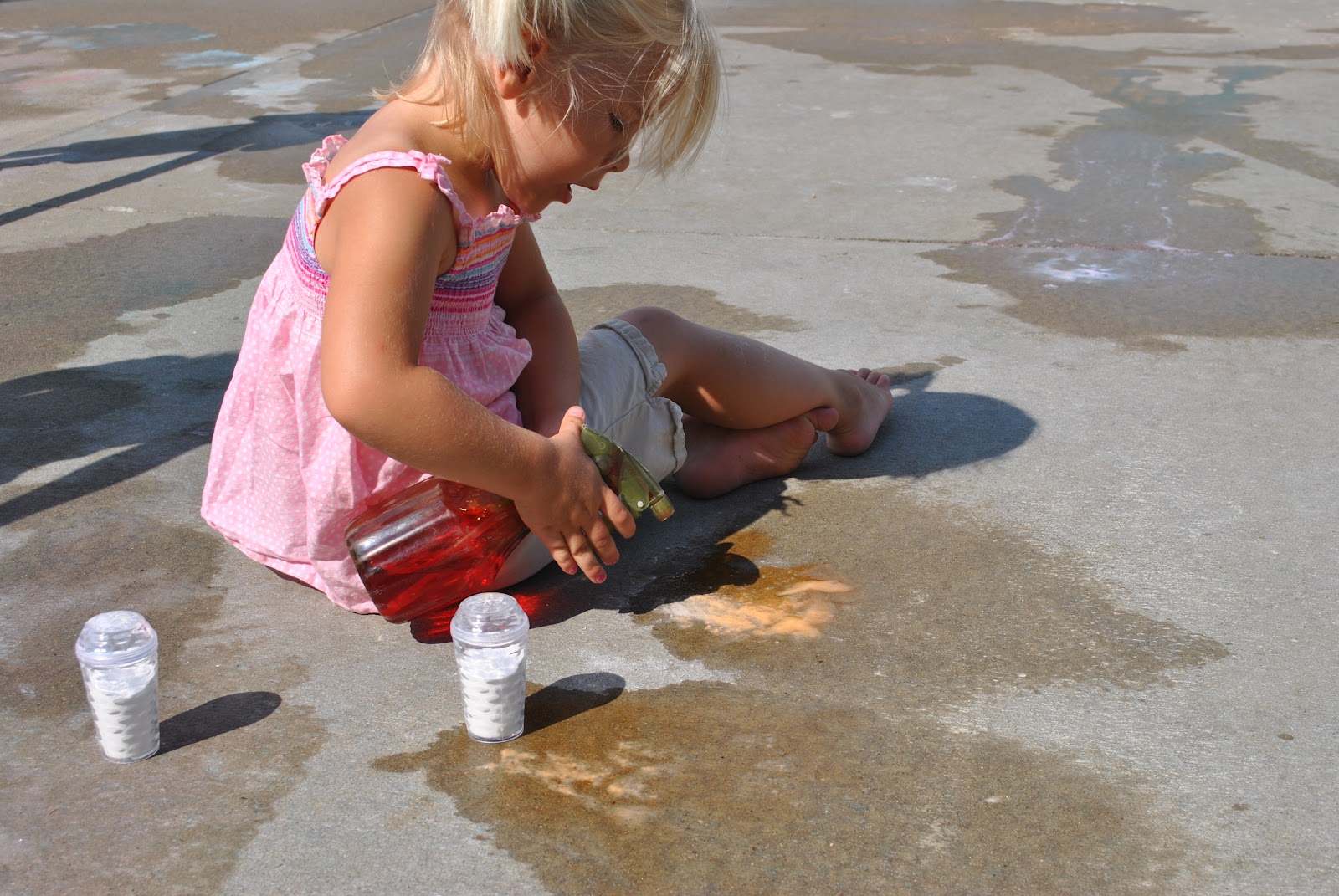
(dah dada daaaah!!) Plastic salt shakers to the rescue!  Same concept...just a different mode of transportation and execution for the baking soda!  Just look:


<><><><>
The environment is set.  Supplies are ready.  Pipettes, cups of colored vinegar, shakers of baking soda, and an empty container sitting on a non-slip mat (I learned to do this the hard way...when children are focused, containers can slide away and land on the floor!!).


Squirt.....then shake, nice and neat....this of course didn't last long as the container filled with a kaleidescope of colorful vinegar and fizzing reactions!  Soon there was shaking and squirting, squirting and shaking...reactions everywhere!


<><><><> <><><><>
It was fun to observe as the fizzing puddles started to appear.  One puddle, then two..then soon....one giant puddle, all contained by the walls of the bucket.

Teamwork

Lots of teamwork created a BEAUTIFUL rainbow, and a container-sized puddle of fizz!

baking soda and vinegar reactions
Squeezing, grasping, muscle control (if the shaker hit the vinegar, it would clog the holes of the shaker making it useless) and working together....all valuable life-long skills.

NOW...fast forward to ANOTHER day.......

Brace yourself for.....

VINEGAR GONE WILD!!

Remove the container, and set that vinegar and baking soda reaction free! 

****IMPORTANT NOTE:  BEFORE setting the vinegar free, we all sat down and talked about the fact that there was now vinegar in the spray bottles, and we must not spray our friends or the grass (and of course, we talked about WHY, if you give guidelines remember to explain the WHY).  My crew did WONDERFULLY at following those simple guidelines.  Why?  First of all, because they LOVED the opportunity and didn't want to lose it. They also thrive on opportunities to earn our trust.
 "Danger" makes young children feel responsible and important...children respect danger.  Is vinegar all that dangerous?  Of course not...but just enough to garner an opportunity for trusting!*****

fizz, toes, sensory
Free the vinegar!! (just keep it out of the grass!!)

 Little hands and fingers need strengthening.  The more opportunities for squeezing the better!  Finding the right motivation is the key.  Children will try and try until they are successful if they are provided with the right motivation!


****TIP***** 

I first filled the bottles about 1/4 of the way with water, then the coloring and then the vinegar.  Water downed vinegar gives you the same reaction and makes the vinegar last longer!  Later, we added one more element that caused a fun change to the reaction....read on!

First the shaking


Then the spraying...ahh teamwork!!
There is a lot of learning to be found in causing reactions. Both negative and positive reactions hold many lessons and provide children with life-long skills. 

Negative reactions (causing someone else to react to something we did in anger or disapointment is what I consider a "negative reaction") teach us about feelings, consideration and respect.  We learn how to express our feelings with words and feeling of compassion.  We learn an awareness of how others feel too.

Positive reactions can hold a treasure chest full of learning....teamwork, expressing ourselves, sense of pride, learning from trial and error, persistance, cooperation, sharing and patience just to name a few!

Collaboration at it's finest.  Erik took the lead roll and felt great importance when he told Amelia when it was time to shake more baking soda on.  They made their own pile of fizz for about 3 minutes...that's when the other children needed Erik and his purple vinegar STAT!
Thanks Erik!  Purple was just what this fizzing puddle needed!
 For an added twist, I added bubble solution to the vinegar bottles...this causes a slower, foamier fizz.
I loved all the teamwork that came out of this.  I thought there would be teams of shakers and sprayers, but it was fun to watch the sprayers join forces to create colorfull puddles of fizz!
I have found, that when provided with opportunities to cause positive reactions, most young children show little interest in hunting down negative reactions. One of those reasons is they just don't have time because they are consumed with the task at hand.  The other is their desire to cause a reaction is satisfied.


Teamwork is a good thing, yes...BUT there is something to be said about having all the supplies to yourself!

If you're going to set the vinegar free...it's only fair that you set those piggies free too!!!
Make sure there are opportunities for children to learn through cause and effect every day!  These opportunities can be as simple as kicking or throwing a ball, they do not need to require a lot of supplies or set up.
Here is a quick list of some of our favorite "cause and effect" activities off the top of my head:
  1. balls of all sizes
  2. parachute with various objects to be tossed around (if you don't have a parachute grab a bedsheet or table cloth)
  3. water and cups
  4. rice and cups
  5. ANYTHING that can be poured and dumped
  6. ramps (see post for ideas)
  7. paint brushes and water for outside play (my crew LOVE to paint the cement with water and make it change color!!)
  8. bikes, cars, push toys
  9. Squiggles (see post)
  10. baking soda and vinegar variations  (see post)
  11. goop (see post)
  12. bubbles (post 1 and post 2 about bubbles)
  13. shop vac  (toy #1 at my house!  A shop vac that is STRICTLY FOR PLAY) My crew LOVE to suck up colored rice or fluffy pom poms, then turn it off, open it up and dump their hard work out just to do it again!  They also love the blow side (my shop vac sucks and blows).  We have a blast blowing light plastic ball-pit balls around the room, silk leaves or silk flower pedals too!  On the suck side we love to see what objects the suction is strong enough to pick up (books, various toys, containers, paper etc.) 
  14. "Rainbow Rain" -- at an easel, the child colors lines with washable marker at the top of the paper, then sprays the lines with water and watch as the colors run down the paper!
  15. Absorbing colored water with papertowel.  Put out cups of colored water and pipettes..let the children squirt colored water onto the table, then lay a piece of paper towel on top...watch as the colors are absorbed into the paper towel.   
This is a small list that will hopefully get your creative juices flowing!!
Once again, I firmly believe:  PLAY COUNTS!!


Tuesday, June 5, 2012

One Thing Always Leads to Another

All that was plopped was a 10 ft. plastic raingutter bridged between two tables and held in place with sticky putty (that you use to hang things on the wall) and a mixture of magnetic items  ( 1-2" pipe cleaner bits, paper clips and magchips) and mag-wands.  ****KNOW YOUR CREW!! ARE THESE ITEMS SAFE FOR YOUR PARTICULAR GROUP OF CHILDREN??****

My only expectation was that the children would discover moving the items in the raingutter using the mag-wands UNDER the raingutter.   We had previously made some other discoveries through magnet play, and I wanted to see if they would take that knowledge and apply it to a different situation. 
At first, my crew used the mag-wands on top of the raingutter..fun, but not as fun as what I had invisioned.  I quietly observed...and waited for more discoveries.
Eventually, through trial and error, the discovery I was patiently anticipating happened.  Superman (on the right in the above photo) discovered it completely by accident...actually, it was flower child on the left that discovered it, but it was Jack's wand that made it happen.  Flower child saw the pipecleaners mysteriously moving as Jack was just carelessly dragging his wand along the outside of the raingutter..,  They both were thrilled, even though Superman really didn't have a clue as to what he had done to cause such excitment!

As always happens when children are given TIME to PLAY, one thing leads to another.  My crew (or as one of my reader's refers to young children, my "littles"  LOVE THAT!!) added the next plop: metal balls from a Magtastik set I bought several years ago.  ****please note, this toy has been recalled due to some smaller pieces in the set...BUT, the metal balls that came in it are AWESOME for magnet play!*****
Two year old Molly is making things happen, a BIG deal for a two year old!

Adding the balls created conflict.  Conflict in play is a GOOD THING.  How else can we practice conflict resolution if we never have conflict?  The balls took up the entire space in the raingutter...no ball could go past another ball.  The other conflict was the pipecleaner pieces made it difficult to maneuver the balls.  Problem solving and conflict resolution....both resulted in teamwork.... LOVE IT!!

As interest and motivation fades, we "professional brain developers" get the esteem honor of assisting in one thing leading to another.  We can have just as much fun as the children by staying one step ahead of them and quietly plopping new things that takes the current play in yet another direction. 

After observing some pretty impressive conflict resolution and problem solving,  I thought it would be fun to add some color mixing to this activity.

Enter plop #3 stage right:  paint. 

The "littles" had removed the assortment of smaller magnetic objects (pipe cleaner bits etc.) in order to run the balls more smoothly (YES! Problem solving!), so I just quietly squirted in some yellow paint and stepped back to observe.  OH THE EXCITMENT!!


One color isn't nearly as fun as two!  So blue was added next, and shortly after...red was requested!


I love that the children cannot see their hands when they are doing this activity.  It helps with their spatial awareness (aka:  proprioception....just being aware of where our parts are in space and moving them where we need them to be without looking at them).  I also love that they were making things happen in an entirely new way!  How empowering!


Gavin is testing his own hypothesis:  Can the ball be passed from one magnet to the next?

The child on the right was having a lot of trouble with her ball getting stuck in the paint, and the magnet losing contact with the ball.  She showed a tremendous amount of persistance...never once did she give up...she just tried and tried and tried.  Persistance is a very valuable, life-long skill!
Again...one thing led to another with a little assistance from me.  As the larger magnetic balls started to get difficult to manuever from the increasing amounts of paint,  I traded them out for the smaller magnetic balls similiar to these available at Discount School Supply (mine are slightly bigger then regular marble size, the ones on this link have a 1 1/4 inch diameter)
The awesome thing about the magnetic marbles is they are smaller, and can squiggle all over the place, leaving behind really fun trails!  They could also STRING together (which happened to be our mystery word on this day!)

The children were mesmerized by the squiggles they were making in the paint.  (Squiggle would be a GREAT mystery word to accompany this activity as well!  You could combine it with this SIMPLE plop)

Ty was proud of his discovery...the balls can string together AND he can make them hang from the side!!

  
The boys are testing previous knowledge with new materials...SUCCESS!  It works! 

Working independently together.  When the moment arises, teamwork was incorporated in an otherwise independent moment.  Then enter in problem solving when each boy's marbles stuck together making a string of marbles.  How to get them unstrung without touching the paint-covered marbles.  It was interesting to watch the problem solving through trial and error.  They finally resolved that they had to touch the marbles.  Neither wanted to take the time to get messy -- it was quite humorous to listen to the debate! :)

Ty ( on the right) is demonstrating his previously discovered technique of taking the marbles up the side of the raingutter as Ethan prepares to lead his marbles past Ty's. The forethought and planning involved in order to orchestrate this was very impressive.
The moral of this post: 
  • Give children TIME TO PLAY. 
  • Let one thing lead to another. 
  • Be present, think ahead and be prepared to assist when necessary in order to help one thing lead to another.
  • LET PLAY COUNT!!

Thursday, May 31, 2012

Simple Things

Teaching young children does not have to be a big fancy production.  There are amazing discoveries to be made with the simple things.

Mystery word: 
string  (What's a mystery word?  Click to learn more)

What evolved from the mystery word? 
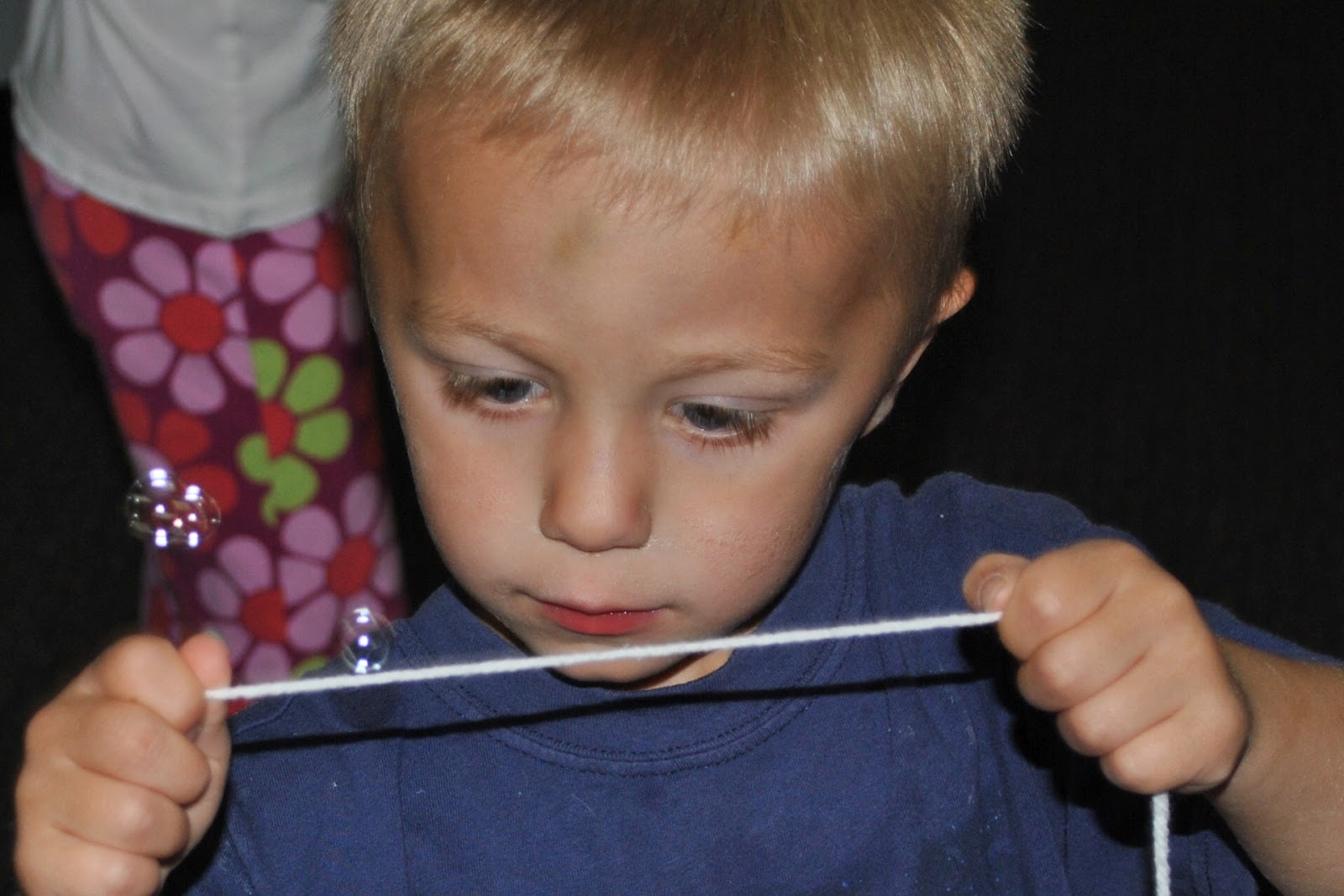
After stringing beads on pipe cleaners and stringing metal balls together with magnet wands and sticks (that led to some amazing discoveries...blogpost coming soon), then strumming the strings of my guitar, into my mind popped a beautiful image of strings of bubbles. 

When we were finished singing our hearts out with the strings of my guitar, I quickly prepared the next "plop" (a plop is simply placing something new into the environment while being able to set aside adult ideas in order to follow the lead of children.  Sometimes the plop leads right to my "plan", but more likely then not, it leads to something that my fenced-in adult mind would have never dreamed of!)

I plopped:
  •  bubbles (the sticky kind, great for indoor play...Gymbore Bubble Oodles are my favorite
  • roughly 1ft pieces of string (yarn)
In my mind, the goal was to make a string of bubbles. I never told the children the task however.  I wanted them to own this discovery and figure it out all on their own.  All I did was lay the pieces of string on the ground and started blowing bubbles. It didn't take long before someone exclaimed "NITA! LOOK! I made a string of bubbles!!"


Visual planning, visual tracking, proprioception (knowing where our parts are in relation to other things and people...I've always referred to this as spatial awareness), cooperation, self control, muscle control and words, words, words are just a few of the benefits of bubble play.


Learning does not have to come in a fancy package.  Most of the time it is found in simple things, like string and bubbles.  You know what I'm going to say next.....PLAY COUNTS!!

Other posts containing "simple things":


Tuesday, May 29, 2012

Preparing for Life with Slimey Motivation

Are you preparing young children for kindergarten?....or for life?

 At my family child care program, we focus on preparing for life.

 We solve problems, we share, we are kind and we practice self control.

We get our muscles ready for important tasks and use our imaginations so we can solve problems and be innovative.   

We discover that it's okay to mess up because we learn just as much through our mistakes as our successes. 

We explore our world and question and follow our curiosity until we are content, and sometimes ... even after! 

We test hypothesis's and challenge old discoveries just to make sure what we know to be true, is still true.

We ask for what we need in order to accomplish all of the above.

We look at the big picture...these are skills that will take us much, much further than kindergarten!
The best part?

We practice these life-long skills through play. 

Part of my job as an early childhood professional is to provide opportunities that motivate children to, unbeknownst to them, practice life-long skills. 

Are you interested in  a good motivator for polishing up the skills of sharing, using imaginations, practicing self control, grasping, squeezing, manipulating, inventing, problem solving, handling conflict and cooperating?

Natural clay.  Good old, slimey, messy natural clay!

The following photo shows not only muscles being strengthened and coordination being practiced, but terriotories being claimed.  Each child has access to a portion of the clay clump....notice how they each have staked their claim?  Alos...one child isn't so sure about this stuff...see the set of hands on the right?  They are hesitant hands just checking out this "stuff".
Simply plop the clay into a large container, add a splash of water to help keep the clay moist and some tools (ice cream scoops work REALLY well) then step back and observe young minds at work!

Clay offers a way for young children to organize themselves so they can work together sharing supplies and respecting each other's projects.
Organizing the environment BEFORE messy play begins provides security (some children need the reassurance that their once clean hands are not far away) and allows plenty of room for all to enjoy playing!  In this photo we see two buckets, both with a clump of natural clay, tools, sea creature beads and some plastic lizards and the purple hand washing bucket placed strategically between.  You control the environment, so the children can control the play!

Clay offers boundless potential.  There is no right or wrong way to explore clay.  It washes off of everything.  No matter how clay is explored the benefits are there.  Language, sensing, sharing, strengthening, coordinating, cooperating, organizing, discovering, imagining...it's all possible with clay.


My job is to motivate and observe.  After some exploration, I added two things, with no direction:  A cup of blue colored water and some pipettes....
Soon after the children dug in, I added a glass of blue colored water and some pipettes...just to see what would happen...
I stepped back and took pictures.  The cleverness of young children never ceases to amaze me!  It did not take long after the addition of colored water for a waterfall to emerge!
They pipettes combined with the clay created a problem to be solved.  The tip of the pipette easily filled with clay, and would no longer work.  It didn't take long for the children to work together to first of all figure out the problem and then, to solve it.  I could have easily stepped in and said "boys and girls, do not put the tip of the pipette into the clay, it will ruin the pipettes and they won't work anymore" -- but, there is very little learning in words alone.  Trial and error is a far better teacher.
Shortly after the addition of the blue water, a waterfall emerged from the clay!

The texture of the clay is smooth and slimey.  It is super fun to manipulate with one's fingers as the clay follows directions quite easily!

One of the benefits of playing in a bucket of clay for an extended period of time (over an hour in this case) on a windy day is "monster hands" -- how very exciting!!


Natural clay is great for those of you who struggle with messy play.  It doesn't hurt clothing, and it washes out of hands, hair and the driveway with ease. 

Here are some tips I have learned along the way:

1)  cleaning up clay is far easier when it is wet vs. dry.  Let the children help with the clean up!  It is play to them...not work!!

2)  store the clay in a plastic bag until the next time

3)  If the next time will be the following day, leave the clay in the container and put the whole thing into a big garbage bag and seal it.

4)  I bought my clay at Michael's Craft.  I got two 10 lb slabs for $8.99 each.  I used a 40% off coupon for one slab....so it was actually cheaper then that.

5)  you can use the clay again and again.

6)  After lots of play opportunities, you can let the clay airdry, then add water to it the next time you want to play for an entirely different experience!


Want more clay play ideas?  Read Plop Your Way to Amazing Clay Play!